Crossover has become an annual and integral element within my photographic life. Indeed, within this nocturnal practice, I am able to find moments to reset.
In 2022 I began photographing forest fires during the winter full moons. At the outset, this effort intended to understand these locations, to feel this liminal moment during the depths of winter before regeneration occurred. My gut told me there was beauty to be found here, but no one else could see it.
Removed from the typically depicted environment directly after the burn, the moonlight and snow destabilise our perceptions much like during the moment fire professionals refer to as Crossover (when the ambient temperature increases to a point higher than the relative humidity). Smoke may cause day to appear like night, and the fire brightens the night skies to those of daytime. We need to recalibrate.
In Dark Days at Noon: The Future of Fire, Edward Struzik describes how, since the 19th century, media portrayals of wildfire have shaped a cultural response of fear that positions fire as an enemy. This settler-based perspective contrasts with long-held Indigenous understandings of fire as a vital ecological process. As this knowledge comes to the fore, we find ourselves at a point in time where our relationship with the media is being re-evaluated, perhaps re-perceived.
My gut was correct, and I found sublime and beautifully transparent forests, the moonlit shadows inking lines that described the topography of the landscape.
Early in 2024, I travelled to the Northwest Territories. The previous summer fire ZF009-22 had made headlines as it caused the city of Yellowknife to evacuate its entire population. The city was not lost, but other communities were affected. What took me there was not the resultant to the population, but the resultant to the ecology, of the landscape and of the geography. I wanted to understand this boreal ecosystem and this moment before rebirth, and what it would reveal to me.
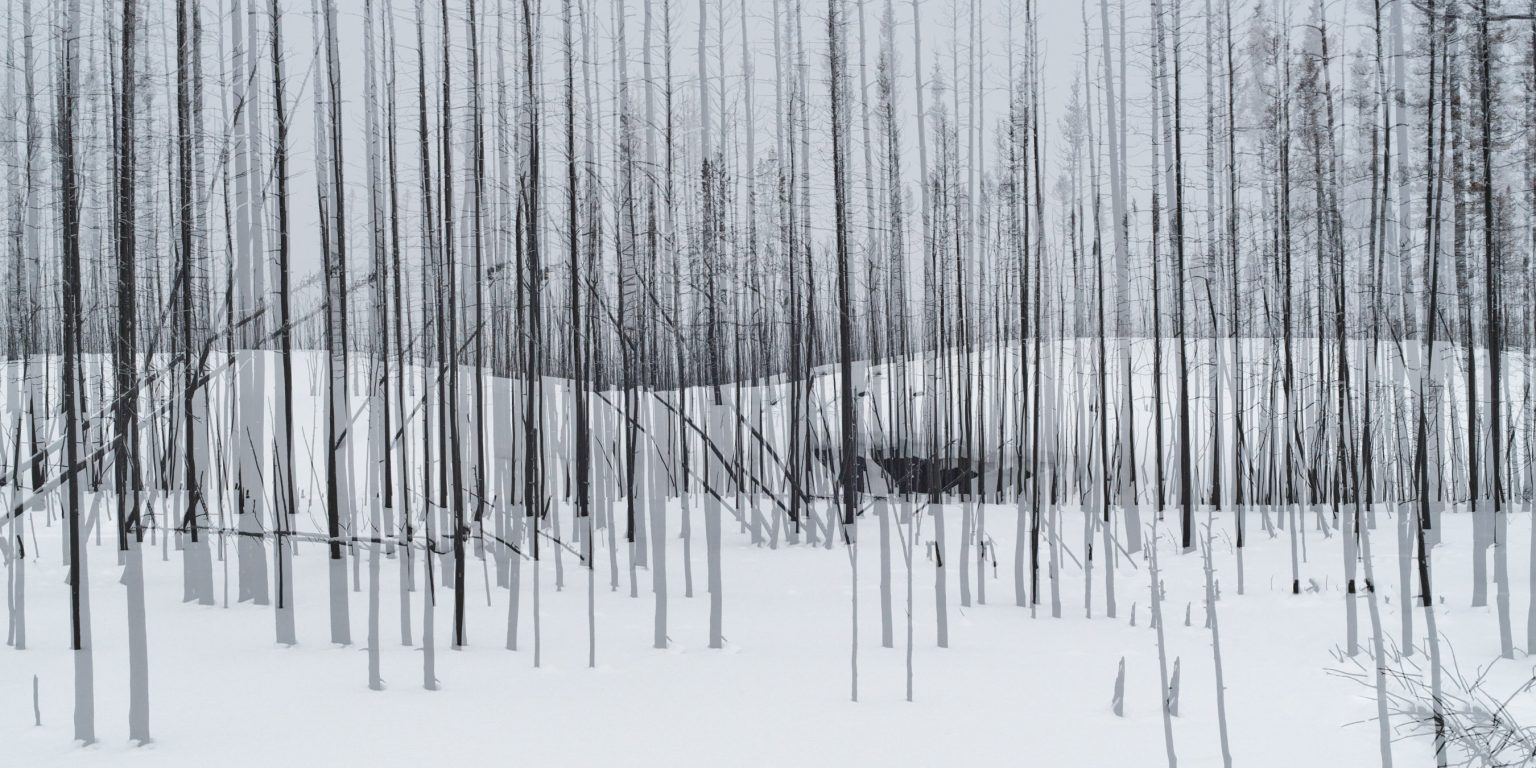
Composed primarily of black spruce, the Canadian boreal forests are designed to burn approximately every 100 years. Crossover: Aquarelle reveals and explores the sparse density of the boreal forest. Continuing my exploration into how we can actively work to maintain an open perception, I employ traditional in-camera techniques to evoke the quiet rhythmical continuity of the boreal forests’ life cycle. Working within the liminal stillness and heightened luminosity of this nocturnal landscape, what I experienced an uplifting emotional response. I later narrowed down to emanating from the sparse density, shifting saturations and the lineal immensity of this beautifully uninhabited landscape.
Within these moments, perception shifts. The landscape is neither fully absent from fire nor defined by it. We are held in a state of suspension where thresholds become perceptible for those who allow themselves time to study. The horizon, a continuity in each panoramic photograph, the multiple exposures of the spruce in greater densities are a dual metaphor for the increasing frequency of forest fires and the inundation of the media in our lives, along with our inability to see past the headlines.
Furthering this perceptual play, Aquarelle embraces an idea that photographs can present not as photographs, extending this idea of liminal space, where perception slows, and subtle transformations emerge. This body of work offers a translucent tactility reminiscent of layered watercolor, where fragility and resilience beautifully coexist in suspended light. They bring a lesson for life, inviting duration, asking us to reconsider what is seen, and how it is held.